
Pakistan’s path to a lower-carbon future will be decisively shaped by the transformation of its agricultural and energy sectors. These two areas are the largest contributors to the nation’s greenhouse gas (GHG) emissions, and the newly established policy tools—especially carbon markets—are precisely designed to funnel investment into them. Data from Pakistan’s 2024 Biennial Transparency Report indicates total GHG emissions of approximately 521–522 million tonnes of CO₂ equivalent for 2021, with agriculture, forestry, land use, and energy combined accounting for nearly 88% of the total. This overwhelming share makes sector-level mitigation the most impactful strategy for altering the national emissions trajectory. Pakistan’s updated climate pledge, or nationally determined contribution (NDC), reinforces this imperative. The country contributes a minor fraction of global emissions yet is acutely vulnerable to climate impacts, making financial mechanisms that attract private capital into low-emission growth. The emerging domestic rules for carbon credit trading, aligned with Article 6 of the Paris Agreement, aim to do exactly that by clarifying how projects can generate, verify, and sell credits while preventing double-counting through measures like corresponding adjustments.
The supporting policy architecture has tightened considerably. In 2024–25, the Ministry of Climate Change introduced Pakistan’s Carbon Market Policy Guidelines, developed with international support, to provide a national framework for voluntary and potential compliance activities. These guidelines formalize key concepts such as project authorization, corresponding adjustments for international transfers, and a digital platform to streamline processes and enhance integrity. This is a practical effort to accelerate clean-technology deployment in high-impact sectors like energy and agriculture by creating predictable, bankable rules for developers and investors.
Parallel tools are also appearing. Pakistan’s Green Taxonomy, finalized in 2025, offers a standard definition for “green” activities, guiding lenders and investors toward sustainable assets. This complements carbon market rules by highlighting priority areas for mitigation—renewables, industrial efficiency, clean transport—and clarifying eligibility for sustainable finance.
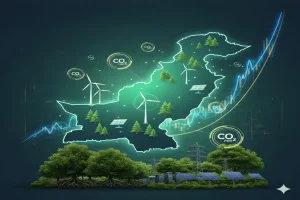
Against this backdrop, decarbonizing the energy sector is both urgent and feasible. Strategic documents like the Indicative Generation Capacity Expansion Plan (IGCEP) show Pakistan’s grid in transition, needing to integrate variable renewable energy while managing costs. The least-cost pathways depend on scaling wind and solar power and improving grid flexibility. Carbon revenues can support this by providing a performance-linked cash flow that strengthens project bankability, particularly for storage-paired renewables and industrial systems.
A key pressure point is distributed solar. Pakistan’s rapid uptake of rooftop PV, and the 2024–25 policy debate around net metering, illustrate both the appetite for clean energy and the need for stable policy. A decision in early 2025 adjusted the buyback rate for excess solar power, lengthening payback periods for new adopters. Carbon finance can help cushion this impact. Solar portfolios that quantify avoided grid emissions could generate verified credits to offset lower energy revenue, especially when paired with batteries. For developers, a forward sale of credits can de-risk cash flows.
Provincial programs also show the way. Punjab’s solarization of agricultural tube-wells, supported by subsidies, is replacing diesel or grid-powered pumps. This directly cuts CO₂ emissions and shields farmers from fuel price shocks. With proper metering, these avoided emissions can become credits, particularly when projects aggregate thousands of pumps using standardized methods.
Industrial energy use is another major opportunity. Key industries like cement and textiles face growing pressure from international decarbonization standards. Firms investing in on-site renewables, waste-heat recovery, or efficiency gains can generate credits from verifiable reductions, while also improving resilience. The voluntary carbon market allows for monetizing co-benefits; credits with social and environmental benefits often command higher prices, improving project returns.
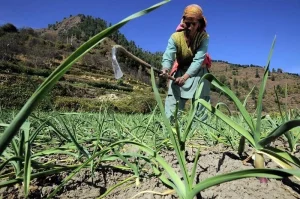
If energy decarbonization is about clean electricity, agriculture is about potent gases like methane and nitrous oxide. Agriculture and land use form the largest single source of Pakistan’s emissions, dominated by rice cultivation and livestock. Methane from flooded rice fields and livestock, along with nitrous oxide from fertilizers, are primary targets. Pakistan has been piloting Alternate Wetting and Drying (AWD) irrigation in Punjab, with research trials measuring GHG reductions versus conventional methods. The development of robust Measurement, Reporting, and Verification (MRV) systems here is crucial, as rice methane credits require credible, field-level data. Scaling AWD where suitable, coupled with proper measurement and farmer aggregation, can create a stream of verifiable credits.
Livestock interventions offer another significant mitigation stream. Feed supplements, improved herd management, and breeding can lower methane emissions per unit of milk or meat. Additionally, manure management via anaerobic digestion captures methane for energy, displacing fossil fuels. Pakistan’s existing biogas programs demonstrate feasibility. Carbon finance can improve viability by monetizing both avoided methane and displaced fossil energy.
Waste management intersects with both sectors. Diverting organic waste from landfills reduces potent methane emissions. Composting and waste-to-biogas projects, like Lahore’s early initiative, can generate urban carbon revenues while producing compost that improves soil health and reduces synthetic fertilizer use, creating a circular loop.
Forestry, while not a focus here, is deeply connected. Sindh’s Delta Blue Carbon project, which has sold over 3.1 million credits, funds coastal mangrove restoration that buffers communities against storms. Such efforts can also stabilize hydrology, benefiting nearby farmland, suggesting landscape-level approaches where carbon credits finance integrated environmental management.
Carbon markets become transformative when they mobilize cheaper debt and risk-sharing. Pakistan’s power sector faces legacy issues like circular debt. Carbon revenues offer a performance-linked income that can lower financing costs for renewables and storage. In agriculture, smallholders need support to adopt new practices. Aggregators—cooperatives or provincial entities—can pool interventions, then use future carbon revenues to secure commercial financing. Pakistan’s new climate finance architecture is designed to align flows with these priority sectors.
The MRV challenge is central, and mastering it is where Pakistan can build credibility. In energy, digital metering and telemetry allow precise measurement of avoided emissions. In agriculture, low-cost sensors and remote sensing are the backbone for credible rice methane or soil carbon projects. The national carbon market rules’ emphasis on robust MRV, plus a digital registry, is vital for building investor trust that credits represent real, additional reductions.
Policy stability is equally critical. Transparent consultation, predictable pathways, and explicit support for carbon markets can anchor expectations. The goal is to issue high-integrity credits that attract steady demand and resilient pricing.
In practical terms, a carbon-financed pathway looks like this: utility-scale renewables with storage in high-potential zones, using credits to lower costs; industrial efficiency upgrades verified by third parties; district-scale AWD programs for rice farmers, aggregating emissions reductions; and complementary livestock biogas projects. These are not just concepts; variants are already underway, proving Pakistan’s capacity to deliver.
Looking forward, key recommendations include building MRV systems that also serve public policy, pairing carbon revenues with smart subsidies where social returns are high, and maintaining market confidence through predictable—not abrupt—policy changes.
Pakistan will not decarbonize overnight. But the pieces are aligning: a national carbon market framework, a green taxonomy, MRV pilots, and a case for renewables. Carbon markets are a powerful lever, turning avoided emissions into investable capital. For investors and policymakers, the task is to design high-integrity projects in key sectors, measure rigorously, and use carbon revenue to climb the technology curve. This is how Pakistan can translate climate action into sustainable investment and development.
References
Government of Pakistan, Ministry of Climate Change & Environmental Coordination. Pakistan’s Biennial Transparency Report (BTR) 2024. (Sectoral emissions shares and totals).
Government of Pakistan, MOCC&EC. Pakistan Updated NDC 2021 / 2025 NDC updates. (vulnerability; policy commitments).
MOCC&EC. Policy Guidelines for Trading in Carbon Markets (2024/2025). (authorization, Article 6 alignment, digital registry).
UNEP-CCC / SPAR6C. “Pakistan publishes carbon market guidelines / SPAR6C supports Pakistan in launching…”. (policy context and implementation partners).
MOCC&EC. Pakistan Green Taxonomy (2025). (Classification for green finance).
CAREC Institute / GoP slides. Green Taxonomy of Pakistan (May 2025). (taxonomy overview and financing gap framing).
National Transmission & Despatch Company / NEPRA. IGCEP 2024–34 and Revised IGCEP 2025–35. (generation expansion context).
Renewables First. Powering Pakistan’s Future: A PLEXOS-based Study (2024). (system planning insights).
Policy Research Institute for Equitable Development (PRIED). How the Latest IGCEP Fails Renewable Energy Future in Sindh & Balochistan (2024). (resource/geography critique).
Government of Pakistan (Press Information Department) & media reports. ECC approves amendments to net-metering framework (Mar 2025); buyback revised to Rs10/kWh. (net-metering policy shift).
IEEFA. The Future of Net-Metered Solar Power in Pakistan (Aug 2024). (policy trajectory and implications).
Government of Punjab. Solarization of Agri Tube-Wells program portals and notices (subsidy design; mass enrollment).
CCAC / Government collaborators. Pakistan Rice MRV reports & scoping studies (2021–2024); ADB/Development.Asia explainer (Nov 2024). (AWD pilots; sites, measurements).
Dawn (Nov 2024). Rice production faces sustainability challenges. (pilot status update; Punjab districts).
Peer-reviewed & synthesis literature on AWD and methane reductions. (comparative reductions vs continuous flooding).
UNFCCC CDM registry. Pakistan Domestic Biogas Programme (PoA 8024). (programmatic anaerobic digestion).
RSPN. Pakistan Domestic Biogas Programme overview. (institutional implementation).
The Express Tribune (Aug 2025). Lahore to get biogas from animal waste; projected carbon revenue. (new municipal biogas pipeline).
Carbon Market Institute / media. Delta Blue Carbon (Sindh) – first issuance and co-benefits; sales approved to 2042. (blue carbon case).
Arab News; Earth Journalism Network. Pakistan reviews carbon market plans with SPAR6C; Mangrove restoration needs. (policy follow-through; ecological constraints).