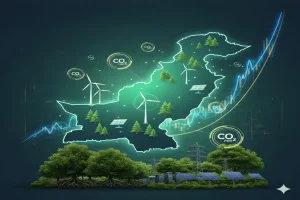

A power plant hums in Poland, racking up its emissions tally. A wind farm in Morocco spins quietly, generating clean megawatts. A forest in Vietnam grows, soaking up carbon. Yet, they are all connected by invisible lines of finance, policy, and of course, carbon. In this unfolding global landscape of climate action, the Emission Trading System (ETS) plays the role of both regulator and opportunity-maker. It’s a system built on the premise that the right to pollute has a price, and the choice to pollute less can be turned into capital.
ETS is not a new idea, but the way countries are bending, stretching, and reinterpreting it is where the real story is taking shape. From quiet boardrooms to the heart of industrial zones, ETS is changing how pollution is perceived, becoming more than just as a liability, but increasingly as a tradable asset.
The Great Carbon Auction
In the European Union, carbon accounting faces a next step: it is auctioned. Companies receive or buy allowances for every ton of CO₂ they emit. Emit more than they’re allowed, and they must buy extra permits. Emit less, and they can sell their leftovers. It’s a cap-and-trade model with teeth, where scarcity drives value and emissions fall year by year.
This system has teeth because the cap shrinks annually. It creates a shrinking budget of pollution. The EU ETS has become a benchmark, not just for Europe, but for what a mature carbon market looks like. But what’s interesting is how others are tweaking the model.
China’s Silent ETS Giant
In China, the world’s largest ETS is emerging, and it’s playing the long game. Starting with the power sector, it’s using historical emissions data to assign quotas. Its focus is beyond just emissions volume, to also account emissions intensity, that is how much CO₂ is released per unit of electricity.
Rather than mimicking Western models, China is embedding its ETS into its industrial strategy. It’s slower, quieter, and deeply strategic. If Europe is running a stock exchange of carbon, China is building a central bank for it.
California’s Carbon Currency
On the other side of the Pacific, California treats carbon like currency. It links its system with Quebec’s, forming a transnational market that’s technically sophisticated and politically resilient. Here, auctions fund clean energy programs, community resilience, and wildfire prevention, becoming more than a climate policy, but also a state budget tool.
The Wildcards and Pioneers
New Zealand lets forests join the game. If trees can absorb CO₂, then planting them becomes a tradeable act. South Korea blends its ETS with aggressive innovation funding. Kazakhstan is experimenting. Indonesia, Colombia, and Mexico are drafting their frameworks. The patchwork is growing. Some countries are even introducing voluntary systems alongside mandatory ones, giving corporations the freedom to offset emissions in ways that align with their brand or regional priorities. Airlines buying African offsets, tech firms investing in mangroves, each one contributes to a mosaic of climate transactions.
What’s Next?
What if the price of carbon on one continent could influence energy decisions on another? That’s already beginning to happen. The EU is launching a Carbon Border Adjustment Mechanism, a tollbooth on carbon-intensive imports. Suddenly, manufacturers in India or Turkey may find themselves adjusting to EU carbon prices, even if their home countries have no ETS. Carbon is becoming global by default.
But it’s not all polished floors and trading screens. The world’s carbon markets still wrestle with data accuracy, double counting, and fair access. Some critics argue that markets can’t solve what politics has broken. Still, others say: if the economy responds to incentives, why not make pollution expensive?
We must remember, that ETS isn’t a silver bullet, it is more like a lever. A quiet, complex, often invisible lever that shifts boardroom decisions, national budgets, and energy investments. On our home turf, in Southeast Asia, where rapid growth meets climate vulnerability, an emission trading system could become both shield and spark, protecting our forests, funding transitions, and redefining development. Whether this region becomes a quiet powerhouse in the carbon economy will depend not just on policy, but on how communities, companies, and governments choose to value the air they share.