
Why “bankability” is the real question
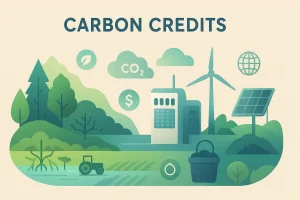
“Are carbon credits bankable?” is not the same as “Are carbon credits valuable?” Bankability asks whether the revenue stream from credits can be underwritten, contracted, and financed, by lenders, investors, and balance-sheet decision makers on terms that justify capital at risk. In Pakistan, that answer now depends on three things that have rapidly evolved since the last two years: (i) a credible national framework for authorization and accounting under Article 6; (ii) price formation and quality signals in the voluntary and compliance markets; and (iii) the contracting, MRV, and governance structures that translate tonnes into financeable cashflows. Pakistan’s 2024 Policy Guidelines for Trading in Carbon Markets move the country decisively toward that bankable frontier.
The new policy architecture: necessary (but not sufficient) for finance
Pakistan’s 2024 Guidelines do three bankability-critical things. First, the carbon credits portfolio in Pakistan lies with the Ministry of Climate Change & Environmental Coordination (MoCC&EC) as the National Designated Authority (NDA) and codify the process of submission of documents for carbon credits registration (from PIN → LOI → PDD → NOC pathway for projects), creating predictability on authorization. Second, there is a progress to establish a National Carbon Registry and commit to a digital MRV system aligned with Article 13 transparency requirements, key to avoiding double counting and giving buyers comfort on integrity. Third, they formalize the economic incidence on credits: a 5% deduction in-kind toward Pakistan’s voluntary NDC, a 12% Corresponding Adjustment Fee (CAF) on net revenues (50% shared with the host province; 50% to the Pakistan Climate Change Fund), and a 1% federal administrative fee on gross revenues. These features don’t ensure a high price, but they normalize counterpart risk and accounting, which is exactly what banks ask for before lending against future credit sales.
Two additional design choices matter for financers. The policy limits corresponding adjustments to within ~280 MtCO₂e (i.e., 50% of the conditional NDC by 2030), prioritizes nature-based solutions (NbS), and signals preferential authorization for shorter crediting periods. Those parameters shape supply, durability, and timing of cashflows—variables that feed any bank’s discounted cash-flow model and covenant design.
Where Pakistan stands in the Paris architecture (NDC 3.0 and beyond)
Pakistan’s Updated NDC (2021) pledged a 50% reduction versus projected 2030 emissions—15% unconditional and 35% conditional upon international support. That framing underpins why Pakistan is now building a domestic authorization regime for ITMOs (internationally transferred mitigation outcomes): to unlock conditional ambition with external finance. The government’s subsequent NDC update (“NDC 3.0”, Sept 2025) reiterates progression requirements and anchors Article 6 cooperation as a means to mobilize resources while safeguarding integrity and national accounting. For lenders and buyers, this signal of continuity reduces policy risk: Article 6 will not be a one-off; it is part of Pakistan’s forward climate planning.
Pakistan has also emphasized its engagement in COP negotiations on Article 6, reinforcing the credibility of its domestic steps with international positioning, another soft de-risking factor that matters to off-takers and investors evaluating execution risk.
Quality and price: the bankability hinge
Globally, the voluntary carbon market (VCM) has been through a credibility reset. In 2023–2024, volumes and values fell; average prices slipped amid scrutiny of baseline setting and additionality, especially in avoided-deforestation (REDD+) segments. The most recent Ecosystem Marketplace 2025 review reports a 25% decline in transactions and 5.5% average price decline in 2024, with total transaction value down 29%, a reminder that price is not guaranteed and quality differentiation is non-negotiable. Banks read these signals conservatively in their downside cases.
Yet the market is not collapsing. Two trends are improving bankability at the top end: (1) quality screens led by the Integrity Council for the Voluntary Carbon Market (ICVCM), which has now approved major programs under the Core Carbon Principles, aiming to standardize integrity labeling; and (2) a slow demand pivot to compliance-adjacent buyers (e.g., CORSIA) and jurisdictional REDD+ offtakes (e.g., LEAF), where prices and diligence are more programmatic. Both trends matter to Pakistan’s pipeline, because bankability improves when eligibility, MRV, and label comparability are clearer.
Consider CORSIA (aviation’s compliance scheme): eligibility lists and auctions are reinforcing a price floor logic for certain unit types. If Pakistani carbon credits (project- or jurisdiction-level) achieve CORSIA eligibility and robust ratings, lenders can underwrite offtake contracts with greater confidence on resale/retirement liquidity.
Bankability 101: what lenders and investors actually underwrite
From a finance perspective, carbon credit revenues become bankable when six risks are mitigated:
- Policy and Authorization Risk
Can the project get and keep the LOI/NOC; will corresponding adjustments be granted; is the registry live; are rules stable? Pakistan’s 2024 Guidelines materially reduce this risk by formalizing the NDA role, digital MRV, registry, and authorization/CA pathways. Periodic review is anticipated, but the framework is now explicit. - Legal & Title Risk
Who owns the credits (and non-carbon benefits)? Are community rights clear? Are ERPAs enforceable under local law? The policy’s Annexes call for documentation on land rights, permits, grievance redressal, and benefit-sharing—foundations lenders want to see in the data room. - Delivery (MRV) Risk
Can tonnes be generated and verified on schedule, to a method the market trusts? Pakistan’s planned MRV system and public transparency commitments help, but developers still need project-level MRV discipline and (ideally) external quality ratings to de-risk issuance. ICVCM’s CCP label will help normalize program-level quality screening. - Counterparty (Buyer) Risk
Is the offtaker investment-grade or backed by escrow/LCs? Jurisdictional or CORSIA-linked offtakes trend stronger on credit quality; voluntary corporate buyers span a wider spectrum. Evidence from aviation and jurisdictional buyers suggests more contractual discipline than purely opportunistic VCM purchases. - Market/Price Risk
What happens if prices fall 30–50%? EM’s 2025 report shows why price floors, collars, or minimum-price ERPAs are meaningful in Pakistan, these would cushion the CAF/fee drag and protect DSCRs. - Reputational & Integrity Risk
Could a methodology or project type face a headline shock? ICVCM’s program approvals (covering the vast majority of retirements) and method-level assessments in progress aim to reduce the “all credits are equal” illusion—critical for banks deciding if a given stream merits lending at all.
Prices: what to assume (and what not to)
It is tempting to anchor to a single number, but prudent underwriting uses ranges and labels:
- Quality-labeled, compliance-adjacent credits (e.g., CORSIA-eligible, CCP-labeled) tend to command a premium and offer better offtake liquidity. Banks prefer these curves.
- Generic VCM has been in a price-discovery phase with 2024 average prices down ~5.5% y/y and total value falling; treat spot quotes as volatile and use conservative forward curves for DSCR tests.
On the macro side, carbon pricing instruments (taxes/ETS/crediting) now cover roughly a quarter to nearly a third of global emissions and generated >$100 bn in public revenues in 2024—an indicator that policy-driven demand isn’t going away even if the VCM zigzags. For Pakistan’s exporters and airlines, this policy tide matters because compliance demand often anchors the benchmark against which voluntary prices are negotiated.
Returns after Pakistan’s fees: reading the fine print
Fee incidence matters for bankability, because it affects cash yield per tonne:
- 5% of issued credits are deducted in kind to Pakistan’s voluntary NDC (no cash proceeds to the project on those units).
- 12% CAF is charged on net revenues from sold credits; 50% of this goes to the host province and 50% to the Pakistan Climate Change Fund.
- 1% administrative fee on gross revenues goes to the federal government.
In practice, projects should model price-netback after: (i) deductions; (ii) standard registry/standard fees (Verra/GS); (iii) verification costs; (iv) broker spreads (if any); and (v) taxes. Properly disclosed, these deductions do not kill bankability; they clarify the fiscal wedge and de-risk counterpart expectations—something lenders prefer to “unpriced policy risk.”
What tips a project from “interesting” to “bankable”?
- Anchor offtake early
Use forward ERPAs with price floors (or floors + upside-sharing collars). This locks a minimum cash yield while preserving upside if labels/ratings improve. In some cases, auction-backed or guarantee-backed floors (e.g., the World Bank’s TCAF) have catalyzed private investment, which is an approach Pakistan could adapt through provincial or blended-finance facilities. - Aim for compliance adjacency
Design to CORSIA eligibility (where applicable), pursue ICVCM CCP-labelled programs, and invest in methodology-appropriate ratings. Compliance adjacency narrows the bid-ask and expands buyer pools during market stress. - Choose scalable, verifiable baselines
Methane abatement (waste, manure) with strong usage monitoring, energy efficiency with metered data, and jurisdictional forestry with government buy-in tend to deliver MRV on schedule, which is what lenders really price. Pakistan’s Guidelines explicitly encourage low-hanging abatement and NbS with equitable benefit-sharing. - Provincial alignment and community consent
Because 50% of CAF flows to provinces, provincial governments have incentives to fast-track well-structured projects. Build community benefit-sharing and grievance mechanisms into the ERPA and PDD to pre-empt legal frictions that can impair delivery (as seen in some jurisdictional deals internationally). - Blend to de-risk
Where forward floors are not available from buyers, seek blended finance enhancements (first-loss equity, guarantees) from climate facilities to bring down the project’s cost of capital, especially for early vintages. Institutions like Karandaaz and NCGCL has come into picture now. Global practice shows such instruments unlock private debt at scale when quality and policy are in place.
Article 6 cooperation: from policy to pipeline
Pakistan’s policy is explicitly Article 6-ready—defining authorization criteria, corresponding adjustments, and national accounting. That matters because ITMO trades with sovereign or corporate buyers (under 6.2/6.4 modalities) can be larger, longer-tenor, and more standardizable than purely voluntary deals, and therefore more bankable. Developers should read the policy’s qualification parameters carefully, alignment with 6.2 cooperative approaches and 6.4 design rules, and structure documentation accordingly.
Internationally, Article 6 pipelines and supervisory processes are maturing; program-level quality screens (ICVCM) and compliance schemes (CORSIA) are converging on MRV robustness, additionality, prevention of double counting, and permanence. Pakistan’s decision to mirror these principles in domestic policy reduces jurisdictional arbitrage risk, another plus for lenders.
So—are carbon credits bankable in Pakistan?
They can be, under the right structures:
- Policy risk is now substantially mitigated by the 2024 Guidelines (authorization pathway, registry, MRV, fees). That is a foundational pre-condition for any bank.
- Market/price risk remains real in the generic VCM, but compliance-adjacent, quality-labeled credits and jurisdictional offtakes show better resilience and contract standardization.
- Project delivery risk is manageable for technologies with measurable baselines (methane, energy) and for NbS where jurisdictions lead and community safeguards are explicit.
- Returns after Pakistan’s fee wedge remain competitive where (i) offtake floors exist; (ii) issuance schedules are realistic; and (iii) projects secure strong ratings/labels.
What RF does to turn tonnes into financeable cashflows
Resources Future (RF) is structured around one goal: convert climate impact into bankable revenue. We do this by:
- Pre-feasibility screens: eligibility, additionality, method fit (Verra/GS/A6.4), authorization pathway, CA implications, and provincial alignment.
- Full feasibility: technical baselines, leakage/permanence risk, MRV design, safeguards, and cost curves with Pakistan policy deductions built in.
- Registration and validation: documentation, audits, and registry operations in sync with MoCC&EC requirements.
- Contracting and offtake: ERPA strategy (floors/collars), rating/label pathway (ICVCM/CCP; CORSIA eligibility), and buyer credit diligence.
- Verification and trading: issuance support, retirements/ITMO transfer, and pricing strategy across spot/forward windows.
For manure management, waste-to-energy, cookstoves, solar+BESS, and NbS, RF brings templates, data stacks, and contracting playbooks tailored to Pakistan’s 2024 framework, lowering transaction costs and accelerating time-to-cash.
A practical checklist for developers and financiers
- Confirm policy fit: NDC sector, CA eligibility, provincial alignment, and fee modeling.
- Select the most bankable method: prioritize measurable baselines and robust MRV.
- Pursue quality labels: target ICVCM program approvals and method assessments; explore CORSIA alignment where relevant.
- Engineer the ERPA: floors or collars; volume and delivery schedules; makegood provisions; creditworthy buyers.
- Blend where useful: explore guarantees/first-loss to neutralize early-vintage risk; auction-style price supports are a known catalyst.
- De-risk the social contract: community benefit-sharing and grievance channels front-loaded to avoid legal overhangs later.
The bottom line
A year ago, “bankable carbon credits in Pakistan” would have sounded optimistic. Today, with a national authorization pathway, registry commitment, and transparent fee logic, bankability is possible—if developers structure for quality, compliance adjacency, and contract certainty. The global market is demanding better credits and better governance; Pakistan is moving to provide both.
RF’s role is simple: turn this policy foundation into financeable projects. If you’re considering a project in energy, waste, agriculture, or NbS and want to understand your true price-netback, risk mitigants, and offtake options—our team can take you from first screen to first issuance.
References
- Pakistan Policy Guidelines for Trading in Carbon Markets (2024). Ministry of Climate Change & Environmental Coordination (MoCC&EC). Fees, authorization, registry/MRV, CA scope. Ministry of Commerce
- Pakistan NDC (Updated 2021) & NDC 3.0 (2025). Targets, conditionality, progression. UNFCCC+1
- Ecosystem Marketplace (2025) — State of the Voluntary Carbon Market. Volumes, prices 2024. 3298623.fs1.hubspotusercontent-na1.net
- ICVCM — Core Carbon Principles. Program approvals; quality signaling. Reuters+1
- ICAO — CORSIA Eligible Emissions Units. Compliance-adjacent demand anchor. ICAO
- UNEP-CCC — Article 6 Pipeline. Global cooperation context. UNEP-CCC
- World Bank — State & Trends of Carbon Pricing 2024–2025; $100bn+ revenues. Policy demand backdrop. World Bank+1
- LEAF/Emergent & Reuters coverage. Jurisdictional ERPA pricing and legal governance signals. Emergent+1
- OPIS REDD+ price notes. Illustrative VCM volatility bands. OPIS, A Dow Jones Company
Welcome to WordPress. This is your first post. Edit or delete it, then start writing!