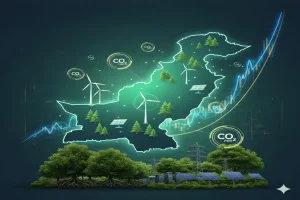

Pakistan’s ambition to participate meaningfully in the global carbon economy is evolving from concept to reality. Over the past year, the country has advanced a structured framework to govern its emerging carbon markets, an essential step for attracting investors and buyers who seek certainty and integrity. This effort is not just about joining an international trend; it is about unlocking new streams of climate finance, driving sustainable development, and supporting Pakistan’s commitments under its Nationally Determined Contributions (NDCs). At the heart of this transition lies the Carbon Market Policy Guidelines (2024)—a national blueprint that integrates today’s Voluntary Carbon Market (VCM) activities with a rigorous international cooperation anticipated under Article 6 of the Paris Agreement.
The guidelines mark a significant shift. They commit Pakistan to building a digital, end-to-end registry designed to minimize bureaucratic discretion, enhance efficiency, and improve transparency. More importantly, they establish the conditions for generating and selling carbon credits that meet international integrity standards. For Pakistan, which remains vulnerable to climate shocks while contributing less than 1% of global greenhouse gas emissions (GHGs), the guidelines signal a policy intent to use carbon markets as a tool for resilience, economic growth, and emission reduction.
Building Momentum: Diplomacy and Capacity
The launch of the Carbon Market Policy Guidelines at COP29 was not an isolated move. It was backed by a wider program of international diplomacy and technical assistance. Pakistan worked with the UNEP Copenhagen Climate Centre and the SPAR6C program (Strategic Partnerships for the Implementation of the Paris Agreement) to craft the guidelines and align them with international best practices. This positioned Pakistan as a credible partner in carbon trading rather than simply a supplier of offsets.
By convening federal ministries, provincial governments, and municipal authorities, the Ministry of Climate Change has sought to ensure that carbon market design aligns with sectoral opportunities. This alignment is crucial: cooperation under Article 6 depends on accurate “corresponding adjustments” to avoid double-counting and on credible MRV (Measurement, Reporting, and Verification) systems. For investors, this demonstrates that Pakistan is building the institutional maturity needed for structured, multi-year carbon transactions.
From Guidelines to Rules: Operationalizing the Market
Momentum has also extended to regulation. In March 2025, the Ministry of Climate Change and Environmental Coordination released the first draft of detailed carbon market rules for public consultation. This marked a transition from principle to practice. The draft rules address project authorization, registry operations, MRV protocols, and mechanisms for dispute resolution. The public consultation process underscored Pakistan’s intent to embed transparency and due process, reducing the risk of policy reversals and strengthening investor confidence.
Parallel to this, Pakistan introduced the Pakistan Green Taxonomy (2025), a classification system that identifies economic activities eligible as “green.” While not a carbon-specific regulation, the taxonomy complements the carbon market by directing domestic banks and DFIs toward green investment projects such as renewable energy, fossil fuel alternatives, energy efficiency, clean transport, waste management, and forestry and land-use initiatives. The synergy is evident: projects that qualify as “green” also tend to generate high-quality carbon credits. This dual recognition improves project bankability by coupling carbon market revenues with access to concessional domestic finance.
Pilots as Proof of Concept
The regulatory framework is being tested through on-the-ground pilots. Between February and August 2025, the Lakhodair Landfill in Lahore was launched as Pakistan’s first Article 6 pilot project. This government-to-government initiative captures methane, one of the most potent GHGs, and converts it into Internationally Transferred Mitigation Outcomes (ITMOs). The pilot serves as a live test of the national registry, authorization processes, third-party verification, and benefit-sharing arrangements. It also highlights the importance of communication and stakeholder engagement to prevent misunderstandings that could undermine projects in sectors like waste management.
The Delta Blue Carbon (DBC) project in the Indus Delta provides another important case study. Initiated before the guidelines, DBC demonstrated Pakistan’s ability to issue and sell carbon credits at scale. The project generated approximately 3.1 million credits, valued at around USD 40 million, and received federal approval for long-term sales. Yet DBC also attracted scrutiny regarding its ecological dependencies, particularly freshwater flows, and sparked broader debates over offset integrity. The lesson is clear: successful projects must be backed by transparent MRV, independent verification, and robust community benefit-sharing mechanisms to ensure credibility and resilience.
Strengths of the Current Framework
Pakistan’s current framework reflects several international best practices. The Carbon Market Policy Guidelines:
- Differentiate between Voluntary Carbon Market (VCM) activities and future compliance markets under Article 6.
- Commit to applying corresponding adjustments to avoid double counting.
- Reserve a portion of credits for Pakistan’s NDC achievement.
- Define a fee structure, including a 1% administrative fee and a formula for sharing corresponding adjustment revenues between federal and provincial governments.
These provisions provide international buyers with confidence in the legal certainty and ledger integrity of Pakistan’s emerging market.
Gaps That Must Be Closed
Despite progress, several challenges remain before private developers, investors, and foreign buyers can fully trust the system:
- Legal Authority and Recourse:The guidelines are not legally binding. Pakistan must enact specific carbon market regulations or a Carbon Market Act, with clear penalties for non-compliance, license revocation powers, and transparent appeals processes. Without legal teeth, enforcement and recourse remain ambiguous.
- Inter-Governmental Coordination: Carbon projects cut across agriculture, forestry, industry, transport, and waste management, all managed by different agencies. A single-window digital portal, backed by service-level agreements (SLAs) with mandated timelines, is needed to prevent bottlenecks.
- Financial Transparency: Rules for fee collection, allocation, auditing, and reporting must be publicly documented. This includes the corresponding-adjustment fee and revenue distribution to provinces. Transparent financial reporting is now a baseline expectation in global carbon markets.
- MRV Standardization: Credibility hinges on robust MRV. Pakistan must publish sector-specific MRV handbooks for energy, waste management, agriculture, forestry and land-use, and transport. It should also accredit independent verifiers, enforce conflict-of-interest safeguards, and ensure public disclosure.
Why MRV Matters Most
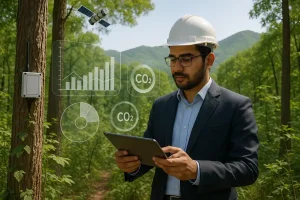
The integrity of Pakistan’s carbon market depends on rigorous Measurement, Reporting, and Verification. Buyers demand proof of additionality, permanence, conservative baselines, and leakage prevention. A credible registry must go beyond storing credit serial numbers, it should integrate remote sensing, IoT data, and audit trails to create an unbroken chain of custody. Pakistan’s pledge to build a digital, end-to-end registry is vital. The architecture, APIs, dashboards, verifier interfaces, will ultimately determine whether credits are considered trustworthy in the VCM or under Article 6 frameworks.
The Buyer’s Lens
Foreign buyers and investors will assess Pakistan’s market across seven dimensions:
- Legal certainty
- Environmental integrity
- Full traceability
- Community benefit-sharing
- Financial clarity
- Compatibility with global standards (Verra, Gold Standard, Article 6.4)
- Liquidity options (secondary trading, forward offtake contracts)
Pakistan has made progress in several areas but must focus on financial clarity, traceability, and demand generation. Early bilateral Article 6.2 agreements with partner countries could anchor demand and provide confidence.
Corresponding Adjustments and Financial Flows
Corresponding adjustments ensure that credits sold abroad are removed from Pakistan’s emissions inventory to prevent double counting. The guidelines’ 12% fee-sharing arrangement between federal and provincial governments is a positive step. To strengthen confidence, Pakistan should:
- Publish a detailed fee rulebook with worked examples.
- Release quarterly transparency reports on fee collections and allocations.
- Maintain a public adjustment ledger linked to project IDs.
These actions would provide the financial clarity that buyers and developers increasingly demand.
Provincial-Federal Coordination
Because provinces control land, agriculture, forests, and local resources, coordination with federal authorities is critical. A unified playbook must allow a mangrove restoration project in Sindh, a solar energy project in Balochistan, and a landfill methane project in Punjab to pass through consistent authorization processes with predictable timelines. A central working group with provincial climate cells and sectoral departments can institutionalize cooperation, reducing bureaucratic delays that currently hinder private sector engagement.
Transparency and Scrutiny: Learning from Delta Blue Carbon
As credit volumes increase, so will scrutiny from NGOs, academics, and media. Rather than resist this, Pakistan’s regulators should institutionalize transparency by requiring disclosures on ecological monitoring, codifying buffer pools for credit reversals, and publishing grievance redressal outcomes. A market that welcomes scrutiny will ultimately achieve higher credit prices and attract greater volumes of climate finance.
A Practical Six-Point Roadmap
To consolidate progress, Pakistan should adopt a near-term roadmap:
- Enact binding regulations to convert guidelines into enforceable law.
- Launch the digital single-window portal with SLAs and public dashboards.
- Publish sector-specific MRV handbooks and accredit independent verifiers.
- Ensure transparent financial reporting, including fee allocations.
- Anchor demand through bilateral Article 6.2 agreements and flagship pilots.
- Commit to continuous improvement via transparent policy reviews every two years.
Conclusion
Pakistan has laid a foundation for its carbon market with the Carbon Market Policy Guidelines (2024), draft rules, and pilot projects. The next steps are about implementation: binding regulations, credible MRV, transparent financial arrangements, and institutionalized coordination between federal and provincial governments. If these are achieved, Pakistan can move from being a promising participant in the Voluntary Carbon Market (VCM) to a credible supplier of high-integrity carbon credits under Article 6.
This transformation would unlock billions in climate finance, mobilize private sector engagement, and channel investment into green investment opportunities such as renewable energy, fossil fuel alternatives, energy efficiency, forestry and land-use with biodiversity co-benefits, and emission reduction projects across waste management, agriculture, industry, and transport. A credible and transparent regulatory landscape is the key to ensuring that every verified tonne of reduced GHGs translates into both environmental integrity and economic prosperity for Pakistan.
References
- Government of Pakistan, Ministry of Climate Change & Environmental Coordination. Policy Guidelines for Trading in Carbon Markets (2024). (Official PDF).
- SPAR6C / UNEP-CCC. Pakistan publishes its carbon market guidelines; digital registry and Article 6 alignment. (Nov 2024 & Jan 2025 updates).
- SPAR6C (PDF). Pakistan Policy Guidelines for Trading in Carbon Markets—Guidance copy. (Document mirror and overview).
- Carbon Pulse. Pakistan opens draft carbon market rules for public consultation. (Mar 14–16, 2025).
- IPRI (Islamabad Policy Research Institute). Analysis of Pakistan Policy Guidelines for Carbon Markets—Policy Brief. (Feb 21, 2025).
- MOCC/GoP. Pakistan Green Taxonomy (2025). (Official PDF); related issue briefs.
- UNEP-CCC / SPAR6C. Article 6 carbon market pilot project in Lakhodair Landfill; Building momentum for carbon markets. (Feb–Aug 2025).
- GGGI. SPAR6C to provide technical assistance to Lakhodair Landfill (press). (Feb 21, 2025).
- Arab News: Verra case study. Delta Blue Carbon issuance, sales approvals, and co-benefits. (2022–2025).
- UNEP. Carbon markets overview and integrity principles. (2024).
- Carbon Pulse. Pakistan’s $2 bn carbon market opportunity at risk without urgent reforms. (Sept 24, 2025).