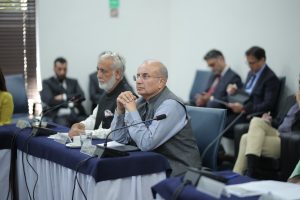

On Saturday, 16 November 2024, at the Pakistan Pavilion in Baku during COP29, the University of Cambridge, through Sustainable Development Law & Policy, Democratising Education for Global Sustainability and Justice, Lucy Cavendish College, University of Cambridge, the Ministry of Climate Change and Environmental Coordination, and the Institute of Business Administration Karachi, entered into a Letter of Commitment to provide 150 full scholarships for online courses of an approximate value of 1,800 GBP. As part of the next steps, the partners have committed to selecting parliamentarians, civil servants, judges, regulators, lawyers, and top graduate students from leading universities in Pakistan to complete the training on SDGs and international obligations on climate. The commitment aims to be participatory, cross-cutting, and gender-responsive. The signing ceremony was attended by Ms. Romina Khurshid Alam, Coordinator to PM on Climate Change; Professor Marie-Claire Cordonier Segger, PhD Chair in Sustainable Development Law & Policy; Syed Bulent Sohail, Head of Program and Partners at IBA ADRIC; and the Patron of IBA Karachi, The Chief Minister of Sindh. This commitment is a covenant to bring top-quality accredited climate education and training to Pakistan in furtherance of obligations under Article 12 of the Paris Agreement. The successful implementation of these trainings will pave the way for further scholarships, engagement, and technical transfer from the University of Cambridge, potentially opening doors for other leading global universities to engage with Pakistan.
Pakistan, as we know, is one of the most climate-vulnerable countries in the world, grappling with the devastating impacts of floods, droughts, water scarcity, smog, glacial melt, and rising temperatures. These climate-related phenomena threaten not only ecosystems but also the livelihoods, health, and economic stability of hundreds of millions of Pakistanis. Addressing this urgent climate crisis requires immediate and focused efforts to prioritize climate literacy across all sectors of society.
Climate education is a tool for fostering resilience, driving innovation, and facilitating informed decision-making, all of which are foundational to confronting climate change. This approach aligns with Pakistan’s Climate Change Act, National Climate Change Policy, National Adaptation Plan, and its commitments under the Paris Agreement.
The Paris Agreement, which serves as a global framework for climate action, emphasizes the need for education, training, and capacity-building. These elements are seen as critical to supporting nations in meeting their climate goals. Specifically, Article 11 of the Paris Agreement focuses on capacity-building, highlighting the importance of assisting developing countries in enhancing their ability to implement climate action through financial resources, technical assistance, and institutional support. Article 12, on the other hand, calls for education, training, and public awareness, with a focus on improving climate literacy and increasing public understanding of climate change.
Both provisions stress the need to empower individuals, institutions, and governments with the necessary knowledge and tools to effectively combat climate change. This global framework is aligned with Pakistan’s goals and underscores the critical importance of climate education for achieving a low-carbon, climate-resilient economy, particularly in developing countries like Pakistan.
To effectively tackle climate change, Pakistan’s education ministries and the Higher Education Commission (HEC) must declare a Climate Emergency and implement a mandatory framework for climate education at all levels. Primary and secondary schools should integrate climate literacy into their curricula, instilling environmental responsibility and sustainable practices early on. This is not only essential for raising awareness but for cultivating future generations that are well-prepared to address climate challenges.
At the university level, institutions must expand their role in developing specialized climate expertise and conducting research on climate solutions. This can help in transitioning from optional initiatives to legal obligations, ensuring universities contribute to climate goals through innovation and advisory services. Moreover, universities should be obligated to act as facilitators for industries, civil society, and government bodies, helping them meet climate commitments. The Higher Education Commission must no longer continue to ignore its fundamental role in this regard.
Primary and secondary schools in Pakistan have the potential to influence entire communities, particularly in rural areas. Climate education in these institutions can create a ripple effect, fostering resilience and building the capacity of students to become local agents of change. Lessons on climate science, conservation, and disaster preparedness can help communities mitigate the risks they face and adapt to shifting weather patterns.
However, effective climate action also depends on the climate literacy of policymakers. Government bodies must lead by example, but they need the knowledge and tools to enact policies that are both responsive and forward-thinking in terms of climate resilience. Sector-specific training for policymakers in climate science, risk assessment, and adaptation strategies is essential to ensure that climate action is both effective and in line with national and global climate obligations.
Educating parliamentarians, senators, local government officials, and members of the establishment—including the top bureaucracy and military leadership—is critical for shaping effective climate policies. These decision-makers play an influential role in shaping regulations and national responses to climate challenges. For bureaucrats, climate education is key to ensuring that environmental sustainability is embedded in various aspects of public administration, making policies in sectors like agriculture, energy, water, and transport more climate resilient. Understanding climate risks is not just the job of the Ministry of Climate Change, but also all high-priority government divisions and departments.
Furthermore, educating military personnel is increasingly important. As climate change intersects with issues like food and water security, internal displacement, and border management, military leaders need to recognize the security implications of climate-induced crises. Training for disaster management, resource scarcity, and humanitarian relief will ensure that military personnel are well-prepared to respond to extreme weather events, such as floods and droughts, and contribute to national security planning.
Industries, particularly those contributing significantly to carbon emissions, must make climate education a core part of their corporate responsibility. Alongside training employees in sustainable practices like renewable energy adoption and waste reduction, it is essential to mandate climate education for executive leadership, including board members, senior management, and trade association office-bearers. Educating decision-makers ensures that climate considerations are embedded in strategic planning and governance. Environmental, Social, and Governance (ESG) frameworks must prioritize awareness at all organizational levels. ESG training should be mandatory for corporate leaders through the country’s well-established corporate governance frameworks. It is incumbent on all supporting professional intermediaries (lawyers, accountants, HR, financial and other consultants) to support mandatory application of ESG and ESRM frameworks of the SECP and SBP, respectively. The temptation to seek (or give) further extensions from the regulator for the application of these frameworks should be avoided.
Community-Based Organizations (CBOs) play an essential role in bridging the gap between national-level policies and local implementation, particularly in fostering a Just Transition. A Just Transition is about shifting to a low-carbon, sustainable economy while ensuring that vulnerable communities are not left behind. CBOs, with their strong grassroots presence, are uniquely positioned to provide region-specific training on climate-smart practices, such as sustainable agriculture, water conservation, and renewable energy adoption.
These local organizations are vital in ensuring that climate education initiatives are culturally relevant and inclusive. They empower communities to actively engage in climate action, contributing to both the achievement of Pakistan’s Nationally Determined Contributions (NDCs) and broader societal alignment and cohesion.
International collaboration is essential for Pakistan’s climate education efforts. Donor agencies and multilateral institutions like the IMF, World Bank, ADB, and others must prioritize funding and technical assistance for climate education through a cohesive framework to give life to Articles 11 and 12 of the Paris Agreement and the action plan for Pakistan. These organizations can facilitate partnerships with leading global universities (through their sustainability centres) such as Cambridge, National University of Singapore, and Durham to incorporate global best practices and cutting-edge research into Pakistan’s climate education curriculum.
Climate education is not just an option but a strategic cornerstone for ensuring Pakistan’s climate resilience and sustainable development. By making climate literacy an urgent national priority, the country can empower its citizens and institutions to navigate and address the challenges posed by climate change effectively. Key steps include declaring a “Climate Education Emergency” to acknowledge and address the prevailing knowledge gap. The Ministry of Climate Change, Climate Change Authority, and Climate Council must activate the dormant provisions of the Climate Change Act, 2017, mandating education and awareness campaigns while integrating climate topics into federal, provincial, and higher education curricula.
Sectoral regulators, such as the State Bank of Pakistan and the Securities and Exchange Commission of Pakistan, alongside professional organizations like the Institute of Chartered Accountants of Pakistan and the Pakistan Engineering Council, should introduce mandatory climate certification as part of corporate governance criteria and professional development frameworks. This will ensure that corporate leaders and professional intermediaries are equipped with the knowledge needed to align their strategies with sustainability goals.
To finance these initiatives, stakeholders should channel a portion of the recommended annual investment in climate resilience—approximately 1% of GDP, as suggested by the IMF—towards climate education. Collaborations with international donors, development banks, and multilateral institutions must focus on creating sustainable, long-term funding mechanisms in line with commitments under Articles 11 and 12 of the Paris Agreement.
By committing to this integrated approach, Pakistan can position itself as a leader in climate innovation and resilience. Such an investment will not only address climate risks but also foster economic growth, create jobs, and attract foreign investments, ultimately securing a sustainable future for the nation.