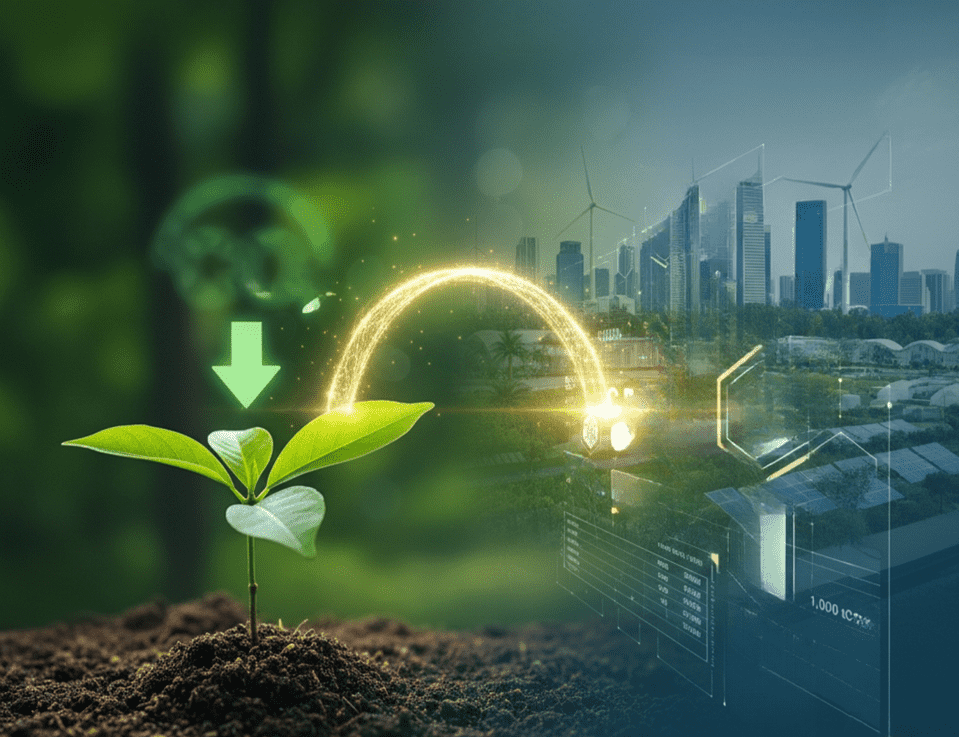
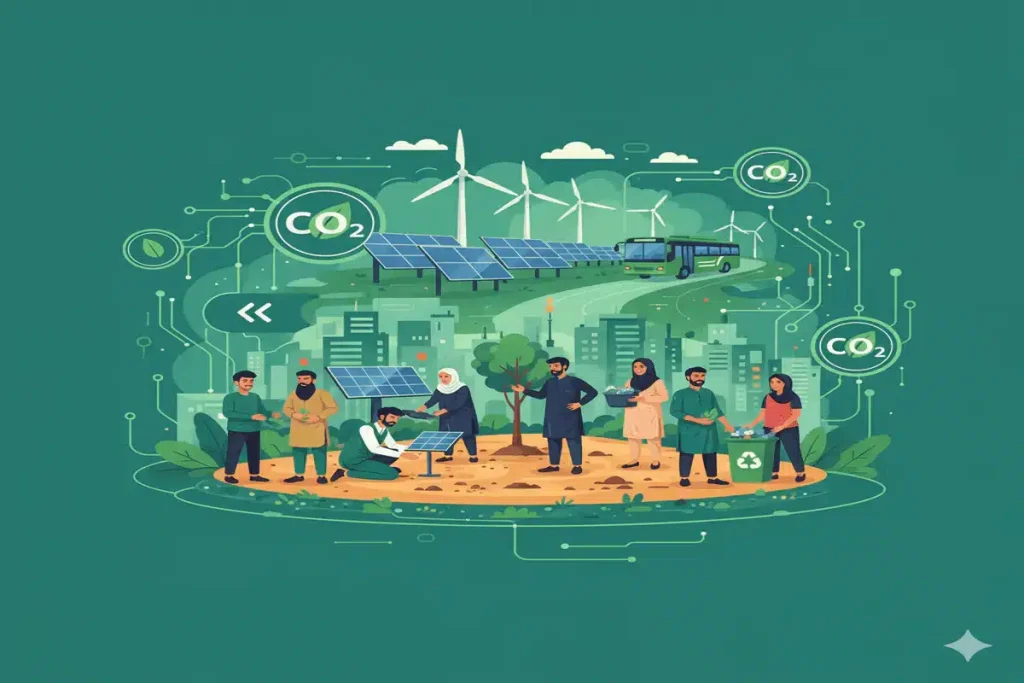
Your renewable energy projects can do more than cut emissions as they can generate certified carbon credits that strengthen returns and accelerate your transition strategy. We help you identify your crediting potential, understand eligibility, and estimate revenue with clarity and confidence. From feasibility through certification, we guide you along the most efficient path so your renewable investments deliver both financial value and environmental impact.
Pakistan’s Value Proposition for Renewable Energy Credits
Renewable electricity replacing Pakistan’s fossil-heavy grid prevents roughly 0.566 tonnes of CO₂ per MWh.
A single wind or solar plant can generate tens of thousands of verified carbon credits annually.
Our Challenge
Pakistan’s energy transition depends on scaling renewable power, yet the financial case for new investments remains weakened by high upfront costs, volatile tariffs, and limited access to concessional capital. Carbon credits can substantially improve project economics, but most developers lack clear, reliable guidance on whether their projects qualify, how many credits they can realistically generate, and which certification pathway is most suitable. The result is hesitation: viable renewable projects remain under-developed, and significant carbon revenue potential goes unrealised.
At the same time, Pakistan’s grid remains predominantly fossil-based, creating large mitigation opportunities that are not being captured. Outdated baselines, inconsistent data, and complex methodologies make it difficult for developers, financiers, and corporates to integrate carbon revenue into their planning or investment models. Without transparent feasibility assessments and a clear route to verification, carbon markets remain underutilised — slowing both the expansion of renewable energy and the country’s broader decarbonisation ambitions.
How We Help
We give renewable energy developers and investors a clear, evidence-based understanding of their carbon credit potential. Using structured assessment tools and current grid emissions data, we determine whether a project is eligible, how many credits it can generate, and which certification pathway—Article 6, Gold Standard, or Verra—offers the best fit. This reduces uncertainty early, helping clients make more confident investment and design decisions.
We also translate complex carbon methodologies into practical steps. Our support includes building baseline and monitoring plans, guiding documentation for registration, and outlining the actions required to reach verification and issuance. Throughout the process, we stay focused on what matters to clients: clarity on credit volumes, cost implications, timelines, and the financial value carbon revenues can add to a renewable energy project. The result is a more predictable, streamlined path to carbon monetisation, with fewer surprises and stronger project economics.
Resources Future has a vast experience in monetizing carbon credits for renewable energy developers. If you are investing in solar, wind or hydel, reach out to us for your free consultation or for any of the services below.

Our Services
Carbon Eligibility & Revenue Assessment
A structured, evidence-based review that determines whether a renewable project qualifies for carbon credits, how many credits it can generate annually, and the expected revenue range under different market scenarios.
Crediting Pathway & Methodology Design
A tailored roadmap identifying the right certification standard (Article 6, Gold Standard, Verra), the appropriate methodology, baseline options, monitoring requirements, and the full crediting timeline.
Registration & Documentation Support
Practical, step-by-step guidance to prepare the documentation required for validation and registration, including baseline and monitoring plans, project design documentation, and support through auditor queries.
IREC registration and support
We support solar project owners in registering their generation under the I-REC standard. Our work covers eligibility checks, documentation, and coordination through issuance.
Solar Power
Utility-scale solar parks, rooftop PV, hybrid micro-grids
Wind Energy
Onshore wind farms, distributed turbines for industrial clusters
Small Hydro
Run-of-river and community-scale hydro plants
Biomass Cogeneration
Agricultural residue or waste-based energy generation
Off-Grid Electrification
Rural mini-grids and solar home systems supplying remote communities